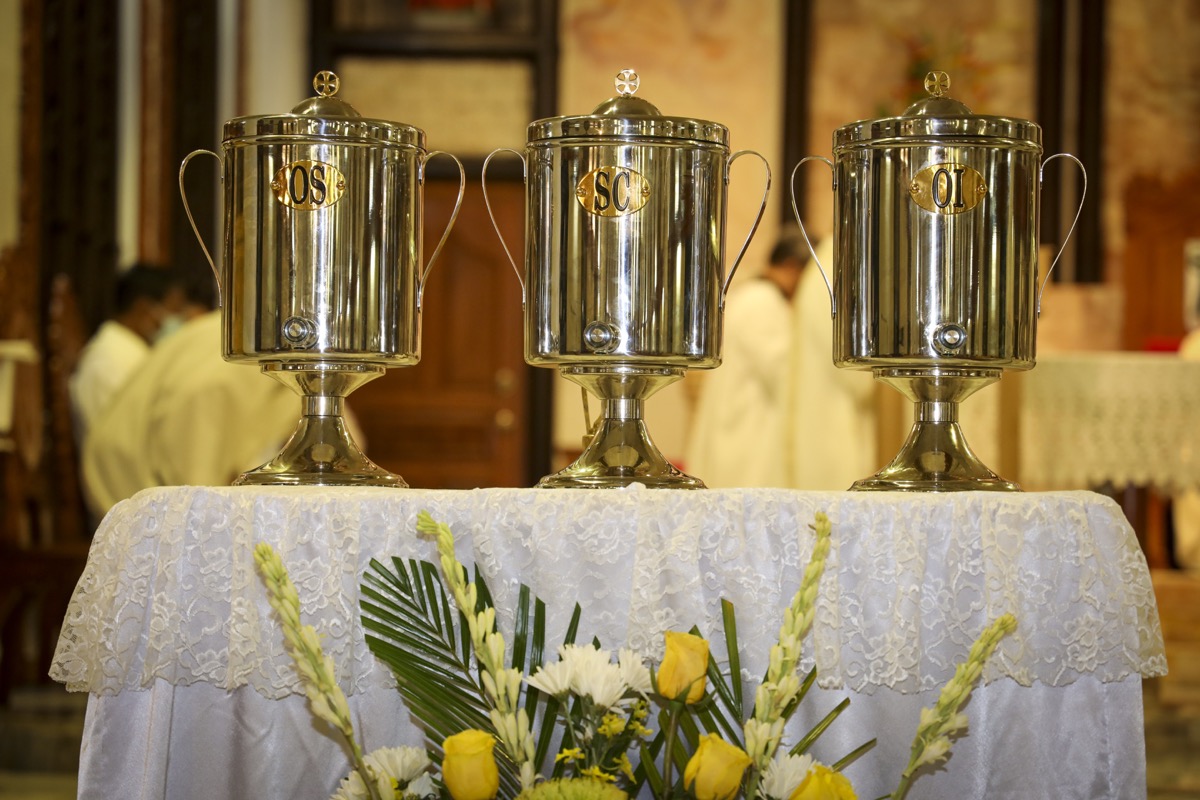
The Church makes use of three holy oils: the oil of the sick, the oil of the catechumens and the holy chrism oil. The first two are blessed, and the bishop consecrates the third, ordinarily during the annual Chrism Mass. Each has a distinctive purpose in the Church.
Oil of the Sick
The oil of the sick, which is pure olive oil, is used for the Sacrament of the Anointing of the Sick. While ideally celebrated with the community during the Mass for the anointing of the sick, this sacrament can be administered any time and in any place. The priest lays hands on the sick or elderly person, says special prayers and anoints the person by placing oil in the form of a cross on the forehead and hands.
Through this sacrament, God gives the sick person grace and strength to bear the illness or infirmity. In addition, many Catholics have witnessed the power of this anointing to bring spiritual, emotional and even physical healing.
Oil of the Catechumens
Both adults and infants prior to baptism are anointed with the oil of the catechumens, which is also pure olive oil. For adults, this pre-baptismal anointing often takes place during a special initiation ceremony when the person begins to prepare for the Sacrament of Baptism. At the beginning of the process known as the Rite of Christian Initiation for Adults (RCIA), each person preparing for initiation is anointed with the oil of the catechumens.
This rite most often takes place during Mass, prior to holy Communion. The priest or deacon anoints the catechumens. Then he prays that God will instill them with wisdom for discernment and with the strength necessary to avoid evil during their inquiry into the Catholic faith and their preparation for a life with Christ.
In a similar way, an infant is anointed just before receiving the waters of baptism. This anointing is to help the child ward off evil, avoid temptation and possess the faith necessary to carry the cross of Christ throughout life.
Holy Chrism Oil
The third oil, holy chrism oil, is olive oil mixed with balsam. The oil symbolizes strength, and the fragrant balsam represents the “aroma of Christ” (2 Cor 2:15). Anointing with chrism oil signifies the gift of the Holy Spirit. It is used to consecrate someone or something to God’s service.
Each year we witness the use of the holy chrism when young people are confirmed, and at the Easter Vigil when adults are confirmed after baptism. The bishop traces the Sign of the Cross with chrism oil on the forehead of the one being confirmed and says, “[Name], be sealed with the gift of the Holy Spirit.”
Chrism oil is also part of the baptismal rite. Following an infant’s baptism with water and before he receives the white garment, the cross with chrism oil is traced on the crown of the child’s head, marking him as a Christian. Anointing on the head is also administered at the baptism of an adult if the person does not immediately receive the Sacrament of Confirmation.
Holy chrism oil is used as well during the ordination of a priest (the Sacrament of Holy Orders) and the consecration of a bishop. It is the anointing used in the consecration of a church and the blessing of an altar and the vessels used at Mass.
The Chrism Mass
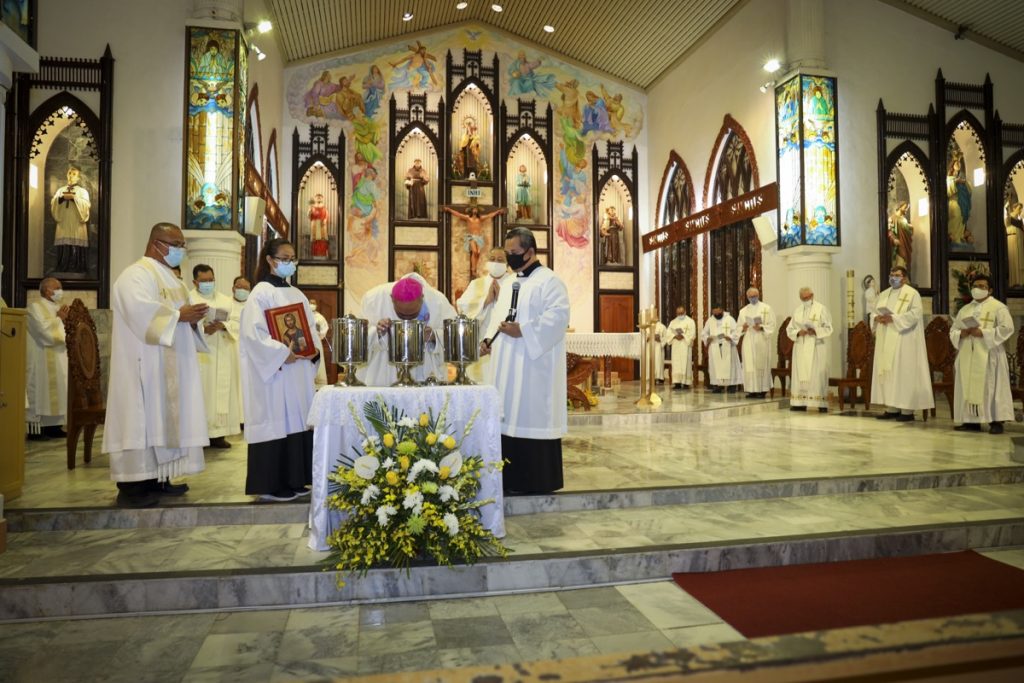
Each year the local bishop blesses enough new oils for every parish during the Chrism Mass. The holy oils are then transported to individual parishes, where they are available for use during that year. Though the bishop cannot be physically present at every baptism or confirmation in his diocese, he can be symbolically present through the holy oils he blesses.
After the Liturgy of the Word, the blessing of the oils takes place. In a formal procession, olive oil is brought forward in special urns; the oil of the sick is presented first, next the oil of the catechumens, and finally oil for the holy chrism. The bishop prays over and blesses each oil individually.
The ritual for creating and consecrating the holy chrism is different from the others. To make it, the bishop mixes oil from the balsam plant with the olive oil, breathes on the mixed oil to signify the presence of the Holy Spirit, and then says a prayer to consecrate it.
Once blessed in this way, the chrism and the other oils are no longer ordinary ointments. Instead, they are a holy, precious gift from God to the Church, signifying cleansing and strengthening, healing and comfort, and the life-giving grace of the Holy Spirit.
by D.D. Emmons | https://simplycatholic.com/