- HOME
- OUR DIOCESE
- PARISHES
- Our Lady of Mount Carmel Cathedral
- Saint Paul Chong Ha-Sang Church
- San Jose Parish-Saipan
- San Antonio de Padua Parish
- Saint Jude Thaddeus Parish
- San Vicente Ferrer Parish
- Santa Soledad Parish
- Kristo Rai Parish
- Nuestra Señora Bithen Delos Remedios Parish
- San Roque Parish
- San Francisco de Borja Parish
- San Isidro Labrador Parish
- San Jose Parish – Tinian
- NEWS
- POLICIES
- NORTH STAR
- BISHOP ROMEO DUETAO CONVOCAR BIOGRAPHY
- CONTACT INFORMATION
- COAT OF ARMS
- STATEMENTS & MESSAGES
- PASTORAL LETTERS
HIS EXCELLENCY,
MOST REVEREND ROMEO DUETAO CONVOCAR, D.D.
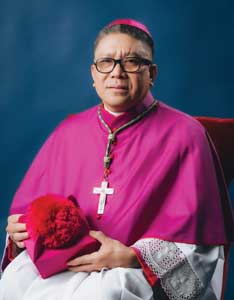 Romeo Duetao Convocar is a Filipino-born Catholic priest appointed bishop by the Holy Father, Pope Francis, on November 25, 2024, and consecrated and installed on March 8, 2025, as the 3rd Bishop of the Diocese of Chalan Kanoa in the Commonwealth of the Northern Mariana Islands.
Early Life and Education
Convocar was born on April 13, 1970, in Janiuay, Iloilo to Cirilo Madero Convocar and Salvacion Pinuela Duetao. He completed his high school education at St. Joseph Seminary in Dumaguete City and stayed on in the same seminary and finished his Bachelor of Arts in Philosophy with a minor in English. He took and completed his studies in Sacred Theology in March 1996 at St. Joseph Regional Seminary in Jaro, Iloilo City.
He also went into military schooling and finished his Technical Service Officers Basic Course (1998) and Technical Service Officers Advance Course (2002) in the Combat Arms School, Training, and Doctrine Command of the Philippine Army in Fort Ramon Magsaysay in Nueva Ecija.
In the years 2018 and 2019, he studied Tribunal Practice in Sydney, Australia, at the Institute of Tribunal Practice, which is affiliated with the Catholic Institute of Sydney and is governed by the Canon Society of Australia and New Zealand.
Priesthood and Military Chaplaincy
On September 17, 1996, he was ordained into the priesthood for the Military Ordinariate of the Philippines. Following his ordination, Father Convocar was commissioned as a military chaplain with the rank of Captain in the Armed Forces of the Philippines. He served as a chaplain officer assigned to various military installations and units, including the A.F.P. Southern Command, Naval Forces North, Naval Forces Central, Naval Base Cavite, and the Bonifacio Naval Station in Taguig City. Moreover, he also served for five years as the Spiritual Director and Procurator of the Domus Josephi Formation House, the seminary of the Military Ordinariate.
Ministry in Guam
In 2006, Father Convocar transitioned to civilian pastoral work in Guam and was incardinated into the Archdiocese of Agana on March 15, 2016. He served the archdiocese as the Parish Administrator of St. Joseph Church in Inalajan, Pastor of San Isidro Parish in Malojloj, and the Rector of the Dulce Nombre de Maria Cathedral-Basilica in Agana, Pastor of Blessed Diego Luis de San Vitores Parish in Tumon.
Additionally, he was the Advocate and Auditor in the Metropolitan Tribunal and the Vicar General of the Archdiocese; following the resignation of Archbishop Michael Jude Byrnes on March 28, 2023, he was appointed as the Apostolic Administrator of the Archdiocese of Agana.
Appointment as Bishop
On November 25, 2024, Pope Francis appointed Father Convocar bishop, and on March 8, 2025, he was ordained and installed as the 3rd Bishop of Chalan Kanoa by the Papal Nuncio, Most Reverend Gabor Pinter, succeeding Archbishop Ryan Pagente Jimenez, who was appointed as the Metropolitan Archbishop of Agana.
Bishop Convocar has demonstrated a commitment to pastoral care, leadership, and service within military and civilian communities throughout his ministry.
Pastoral letters
January 28, 2018
My dear brothers and sisters in Christ,
Greetings of peace!
Migration is – as Pope Francis affirms – a “sign of the times” (cf. Message for the 104th World Day of Migrants and Refugees, 15 August 2017). It is a complex reality that for several years now we have been facing and addressing. On the national level, immigration has been and continues to be a topic of debate and discourse. On the local level, immigration reform continues to be a priority concern due to restrictions on the immigrant workforce and their families.
A few days ago, the Northern Mariana Islands U.S. Workforce Act was introduced on the U.S. Senate floor. The proposed bill seeks to extend the CW-1 program beyond 2019, push the CW cap limit to 13,000 and set a new CW visa category for what will be called “legacy workers” that could be renewed every three years.
With the varied positions and continuing debate on how we as a nation, and as a Commonwealth, will achieve reform, we continue to move forward and do our best – together – to honor the good that is already in place and to change what can be made better. We continue to seek answers, explore options, weigh things, and find solutions. In this regard, I wish to offer some points for reflection, consideration and guidance.
First of all, in anything we do, we should seek and promote the common good – that is, “the sum of those conditions” in society that will enable individuals and groups to grow and be fulfilled (cf. Gaudium et spes, 26). In other words, we should see to it that the social environment, which is composed of many aspects or factors, promotes the growth of individuals and groups in society. Clearly, the achievement of the common good is a concerted effort of people, who go beyond their personal interest or the interest of their own group. Narrow-mindedness is to be abandoned in order to serve the greater good.
We should remember, too, that “in the present condition of global society, where injustices abound and growing numbers of people are deprived of basic human rights and considered expendable, the principle of the common good immediately becomes, logically and inevitably, a summon to solidarity and a preferential option for the poorest of our brothers and sisters.” (Laudato si’, 158)
Second, we should always bear in mind that here, we are dealing with persons. We are not just addressing an issue. We are dealing with persons, who have their own personal stories, their rights and sentiments. We are concerned that local workers have access to jobs. We recognize the contribution of foreign workers and their families to our community. Together we are a strong community.
Once we lose sight of the fact that we are dealing with persons, we tend to be dismissive and detached. It becomes easier for us to have that “throw away” mentality that Pope Francis criticizes. We may come up with quick solutions, but we may end up, too, treating people as expendable.
Third, the reality of migration invites us to examine and to confront ourselves. Are we doing things to maintain “our lifestyle,” “our way of life”? Or are we being invited to change, even our way of life, because that is the good thing to do? Aren’t we perhaps being called to live simply so that others can simply live?
Indeed, “Christian spirituality proposes an alternative understanding of the quality of life, and encourages a prophetic and contemplative lifestyle, one capable of deep enjoyment free of the obsession with consumption... [It] proposes a growth marked by moderation and the capacity to be happy with little.” (Laudato si’, 222)
To those among us who would argue that migrant workers have no place in our islands, I wish to repeat the words of Deuteronomy: “You too should love the foreigner, for that is what you were.” (cf. Dt 10, 19). And to the migrant workers and their families, I wish to repeat what the prophet Jeremiah told the Jewish exiles in Babylon: “Seek the welfare of the city to which I have exiled you; pray for it to the Lord, for upon its welfare your own depends.” (Jer 29, 7).
These words from Scripture remind us to look at one another with kindness, benevolence, and charity; to look at one another as neighbors, as human beings with gifts and talents – not as strangers, not as competitors or potential enemies. We are members of one family. We are all God’s children. Thus, dealing with migration should bring about in us – instead of tension and distrust – a keen sense of solidarity and compassion.
May God bless us all!
Sincerely in Christ,
+ Most Reverend Ryan P. Jimenez, D.D.
Bishop of Chalan Kanoa
Dear brothers and sisters in Christ,
Peace!
As your Bishop, I must exercise my obligation to inform you about several pending bills in our legislature that will affect the common good if enacted into law. These pending bills deal with gambling.
Leadership in a community is a sacred trust. It is the responsibility of everyone in the community - but particularly, the leaders in the community - to pursue the common good for the benefit of the community. (cf. Acts 2:43-47; 4: 32-35.) It is helpful to remember that the common good refers to those circumstances which allow us to become that which God created us to be. Thus, the common good includes not only economic benefit but cultural, educational, spiritual, moral and material development. (cf. Catechism of the Catholic Church, n.1925).
Part of the role of the Church is to be a moral guide. That is, the church must help the community discern what is the best path to take as it establishes policies and laws in pursuit of the common good, based on the principles found in the Gospels.
In discerning the morality of various acts several criteria can be used. A particular act can be seen as inherently good, neutral or evil. An inherently good action should be pursued. An inherently evil action should be avoided. A neutral act should be considered in light of additional criteria. Saving a life or helping someone in dire need would be an inherently good act. The taking of innocent life, as in murder, is inherently evil.
In its desire for a sustainable economic and tax base the CNMI leadership has flirted with commercial gambling for decades. This often has taken the form of poker machines and casinos. Gambling has traditionally been considered by the church to be a morally neutral act. The criteria that are applied is an examination of the consequences of this technically neutral act. That is, what impact does commercial gambling have on the community? Does it promote the common good? Does it work against the common good?
Regarding the various proposals, the church has consistently opposed the various forms of commercial gambling that have been proposed for the CNMI. Commercial gambling has been a consistent source of problems for many people in the local community who have suffered from gambling addiction, loss of property value due to proximity to gambling establishments and increased crime rates. Karidat and our clergy have had first hand experience over the decades in trying to help persons who have been negatively impacted by commercial gambling. It is because of this experience and the negative consequences of commercial gambling that the church has opposed commercial gambling in this community.
Several years ago, a zoning law was passed which provided for commercial gambling but limited it to specific areas that would focus on the tourist industry and avoid the negative consequences it has had on the local community. This seemed a reasonable compromise. Recently the legislature passed HLB 20-48, which rezones previous residential areas into mixed commercial/residential areas, with the intention of allowing commercial poker establishments in residential areas. It appears that this bill will undo the compromise embodied in the current zoning law. Further, the bill was passed without public hearings and contrary to the recommendation of zoning professionals.
As Bishop of the People of God in the CNMI, I respect the right of the Legislature to pass laws regulating public life in the CNMI, even if I disagree with certain measures, such as the expansion of commercial gambling. I respect the right of the Governor to sign or veto those bills sent to him by the Legislature and then to enforce those laws. However, as Bishop, I request that HLB 20-48 not be signed into law. Allow the community to present testimony and debate the issue by holding hearings on rezoning. Provide an example of real leadership, that is not afraid to pursue the common good in the light of public scrutiny and debate.
Sincerely yours in Christ,
Most Rev. Ryan Jimenez, DD
Bishop of Chalan Kanoa
05 August 2018
Dear Brothers and Sisters in Christ,
The heart of Christian discipleship is living out the commandment of love. Love is manifest not only in our single-minded devotion to the Lord but even more so in the actions that flow from our love of neighbor. Such love is realized in the practical charity of individual good works that we perform for the least of our sisters and brothers (Matt. 25:34-46 ) That love is realized in our pursuit of justice for the weak and vulnerable among us as a Christian community. Our pursuit of justice is integral with our mission as a church in which Christ compels us to “go into all the world and proclaim the good news to the whole creation (Mk 16:15). A guide called "Faithful Citizenship" published by the U.S. Conference of Catholic Bishops underlines these thoughts.
There are many challenges that humanity faces which have moral consequences. These challenges are at the heart of public life and the center of the pursuit of the common good (Faithful Citizenship, no.2). The Church has an obligation to participate in shaping the moral character of society. The Church does not support or oppose specific political parties or candidates for office. However, the Church does have an obligation to instruct the faithful on the basic principles to consider when making choices that would have moral implications for society.
In a democracy such as the Northern Mariana Islands, the people have the right to choose their government leaders. Our leaders, in turn, have the obligation to carry out their duties and responsibilities in accordance with the constitution and duly enacted laws. When they do not do so, we hold them accountable. As Christians, we expect our leaders to also adhere to moral principles that further the best interest of the community. The electoral process at every election is the means by which we the voters decide whether we are satisfied with the performance of our leaders in office. This is the way democracy works. And this is the reason why the right to vote is so important.
As Christians, we choose as our leaders those individuals who will advance policies and legislation that do not contradict our faith and morals. This requires us, as voters, to have a well-informed conscience in choosing the individuals who will govern us wisely.
The November 2018 elections will be held in three months. The results of these elections can profoundly shape life in the CNMI for years to come. As individual voters and political candidates, as well as a community of disciples, we share a grave responsibility for the future we are shaping through our choices in the voting booth, and for those who are elected, in their respective offices. As your bishop, I urge you to take this responsibility with great seriousness. Don’t allow divisive politics, ideology or even family ties to sway your decision in the months ahead. Rather, apply the basic moral principles of our Faith to the unfolding political process, so that our political leadership will reflect the best of our community and adhere to fundamental moral principles.
The Church urges each of the faithful to carefully discern the issues affecting our community and to use your conscience in examining these issues. We should always remember that, as Christians, we must adhere to the basic moral principles of the Church that enhance the good of everyone in our community. Toward this goal, we will explore Catholic social teaching in the pages of the North Star between now and November. As part of our Pastoral Plan that we implemented this year, the Social Justice Commission will feature articles on this topic in the North Star. Please make use of these resources in shaping your decision in November and in your support for or opposition to various proposals in the months and years that follow. Be engaged in the political process. Allow your Faith to guide and enlighten your political engagement.
Finally, I invite all of us to pray. Let us pray for the guidance of the Holy Spirit.
Sincerely yours in Christ,
/S/ +Most Rev. Ryan Jimenez, DD
Bishop of Chalan Kanoa
26 October 2018
My dear brothers and sisters in Christ,
Typhoons are not strangers to us. They batter our islands every year. And yet, knowing that it is a fact of life in the CNMI does not make the situation any easier when we are struck by one. We endure the strong winds and punishing rain, as the typhoon sweeps over the Commonwealth. Then we struggle to recover and rebuild in the weeks and months that follow. It is never easy.
A few days ago, we were struck by typhoon Yutu, a category five super typhoon. We are still reeling from the experience and the devastation it caused. Experts say that it will take weeks, perhaps even months, before basic services are restored and we can return to a somewhat normal lifestyle.
As we assess the damage and the destruction wrought by the typhoon, let us turn to God our Father. Indeed, "God is our refuge and our strength, an ever-present help in distress." (Ps 46:2) Like the blind beggar in our gospel this Sunday, let us turn to Jesus and implore him, “Lord, have pity on us!” (cf. Mk 10:47). We can be sure: the Lord will answer us. God will come to our aid.
Let us also help one another. Let us act as one community, filled with serene courage and stirred by compassion and charity. Let us be a sign of Christian unity and love. By the love we have for one another, we make manifest that we are truly disciples of Jesus (cf. Jn 13:35).
Indeed, relying on the Lord and reaching out to one another in compassion, we will get through this difficult time.
We originally planned to celebrate a “mass for unity” this Sunday to remind all the candidates in the coming elections and the rest of the faithful, that despite differences in politics, we are all one in Christ. We wanted to remind people that we must work together and support one another if we are to progress as a community.
In the wake of typhoon Yutu, we find it all the more fitting and timely to celebrate a “mass for unity” not just for our candidates but for each one of us as members of the Body of Christ. We need to come together and encourage one another to reach out to the vulnerable and the hurt among us. We need to work together and seek the common good, especially in the difficult days ahead. Indeed, the nobility and the beauty of a community are seen even in a state of emergency and calamity, in how it attends to the weak and the wounded.
Be assured of my prayers in the days to come. Let us all pray for one another and let us reflect that mutual concern in our actions.
Sincerely yours in Christ,
/s/ +Ryan P. Jimenez
Bishop of Chalan Kanoa
04 August 2019
Dear Brothers and Sisters in Christ,
The Code of Canon Law is a summary of the laws and precepts that govern the Church throughout the world. The Code goes into great detail on the responsibilities of a bishop toward the pastoral care of the people of his Diocese. These responsibilities include providing for the faith formation of all the people of the Diocese, providing access to the sacraments, spiritual enrichment activities, promoting the moral development of the people, promoting social justice, encouraging people to acts of charity and providing for public worship. These are only a few of the duties for which the bishop is responsible.
All of this is beyond the scope of what one person can do. The bishop must call upon all the faithful to exercise the apostolate in proportion to each person’s condition and ability, as this duty to exercise the apostolate flows from their Baptism. In addition to coordinating the apostolate of all the faithful, the bishop must be a good steward of resources, both material and human.
Since being ordained as your bishop, I have striven to meet these responsibilities to the best of my ability. It has never been easy. A troubled economy has limited the availability of material resources. Typhoons have made matters worse by ripping apart our infrastructure and damaging our homes and businesses. This has impacted the church as well, with major damage to several churches. However, the greatest challenge has been with the dearth of human resources. There are 13 parishes in the Diocese. The Faithful of this Diocese have not raised up one of their own to the priesthood in many years. This lack of indigenous vocations and the aging of the local priests who have been in ministry for many years means that the human resources necessary to minister to the people of this Diocese and to pastor the 13 parishes are lacking.
This was a tremendous challenge to the late Bishop Tomas A. Camacho, and it continues to be one of my greatest challenges as the successor to Bishop Camacho. We have attempted to obtain a sufficient number of priests by requesting assistance from Dioceses in the Philippines and Korea, as well as from various religious communities. One of the difficulties though is that there is frequent turn over as a result of visa restrictions and the other ministerial needs of the home diocese or religious community of these priests. While our new deacon community is a big help, they are not priests. Their ministry is important but different from that of a priest. The only sure way to remedy the problem of not enough priests in this Diocese is to raise up vocations to the priesthood from within this Diocese. Toward this goal, I urge you to pray the vocation prayer daily and to encourage your sons to consider the priesthood.
In the meantime, I am faced with the practical reality of providing pastoral care to thousands of the faithful without the resources necessary to achieve this task. One of the ways to make better use of the resources we have available is through sharing these resources. As well as making the best use of the talents that the People of God bring to ministry. A very common model for doing this is called “clustering”. This approach groups several neighboring parishes and missions into a cluster. A cluster may have one priest assigned as a single pastor for all the parishes. Other priests or deacons may be assigned to the cluster as well. They work together as a team, serving all of the parishes in the cluster. Each person brings unique talents to their ministry and all of the parishes in the cluster benefit. Each parish maintains its separate identity, separate bank accounts, separate finance councils while all the parishes in the cluster share the services of their pastoral team.
Given the practical reality of meeting the pastoral needs of the People of God in the Diocese of Chalan Kanoa, I have prayerfully considered alternatives to the approach to ministry that we take at present. The pastoral planning process has been a big help with this discernment. The option of clustering seems the most appropriate path to take at this time. I have discussed this approach with the clergy of the Diocese and with the heads of the parishes’ finance and pastoral councils. The response has been positive. So, as recently announced over the next few weeks and months we will be implementing a series of parish clusters in the Diocese of Chalan Kanoa.
The clusters will include: San Roque, Santa Remedios, Kristo Rai, and San Jose, Tinian grouped into one cluster. Fr. Albert Pellazar, OAR is assigned the team leader of this cluster and Pastor of Kristo Rai with Fr. Neil Bullos, OAR as Parish Administrator of San Roque and Interim Parish Administrator of Santa Remedios until the new OAR priest arrives on the island. Deacon Jeffrey Camacho is assigned as deacon assistant in Kristo Rai and Deacon Tom Schweiger as Deacon assistant in San Roque.
San Jose (Oleai), Our Lady of Mount Carmel Cathedral, and the Korean Catholic Church are grouped as another cluster. Fr. Jason Granado is the team leader in this cluster. He is the Rector of the Cathedral and Pastor of San Jose (Oleia) while Fr. Isidro Ogumoro is Parochial Vicar to both parishes. Fr. Andrew Jang remains the Parish Administrator of the Korean Catholic Church. Deacon Rosiky Camacho is Deacon assistant at the Cathedral.
San Antonio and San Jude parishes are one cluster with Fr. Harold Funa as Pastor of both parishes and Fr. Noli Lim as priest-in-residence of San Antonio. Deacon Stan Benavente is Deacon assistant of San Antonio, and Deacon Tony Yarobwemal is Deacon assistant of San Jude.
San Vicente and Santa Soledad parishes form another cluster. Fr. Jesse Reyes is Pastor of San Vicente and Fr. Charlie Borja is Pastor of Santa Soledad. Fr. Charlie is the cluster’s team leader.
San Francisco de Borja and San Isidro Parishes form one cluster on the island of Rota. Fr. Rey Rosal is the Pastor of both parishes and team leader and Fr. Isaac Ayuyu is the Parochial Vicar of both parishes.
I ask your support and patience as we implement the clustering of our parishes. Please work with your brothers and sisters in Christ who live in the other parishes of your cluster, that working together we can build up the church in this Diocese and meet the pastoral needs of everyone. I ask your prayers for me as well, that I have the wisdom and grace to serve as your bishop effectively. I also ask you to pray for priestly vocations from among the people of this Diocese, as well as encouraging your young people to consider the priesthood.
Your brother in Christ,
Most Rev. Ryan P. Jimenez, DD
Bishop of the Diocese of Chalan Kanoa
September 26, 2020
“Recognizing the Lord Jesus in our midst”
(A pastoral message for the 2020 World Day of Migrants and Refugees)
Dear brothers and sisters in Christ,
Greetings of Christ’s peace!
I first came to Saipan as a migrant worker. I finished my philosophy degree from San Jose Seminary at the Ateneo de Manila in the Philippines and took the mandatory regency program – a time spent outside seminary walls in order to be immersed in the bigger world and to further discern the calling to the priesthood. I applied for a teaching post in the diocese of Chalan Kanoa and was assigned to Eskuelan San Francisco de Borja in Rota. It was the first time for me to live by myself and to be out of my country. A small island, Rota seemed to be just like my home island of Siquijor in the Philippines. I recognized many similarities between life in the island and back home. And recognizing those similarities made things bearable in the first few weeks, and helped me eventually to adjust to the life of a migrant worker.
“Recognizing” – I believe – is a key to reading the message of the Holy Father for the 2020 World Day of Migrants and Refugees. This year’s message carries the theme, “Forced like Jesus Christ to flee.” Pope Francis recalls his 2018 message and reminds us that in the face of this contemporary challenge, we are called to “welcome, protect, promote and integrate” displaced persons (cf. Message for 2018 World Day of Migrants and Refugees). To these words, he adds “another six pairs of verbs that deal with very practical actions and are linked together in a relationship of cause and effect.”
1. Indeed, the call for us is to recognize the Lord Jesus in the migrants and refugees in our midst. This is fundamental. Jesus himself told us that he is present in the poor, the needy, the vulnerable and the oppressed (cf. Mt 25: 35-36, 42-43). In our displaced brothers and sisters, we are given the opportunity to encounter the Lord. In them, we are called to see the face of Christ.
However, there are some blocks that prevent us from seeing the Lord who is right in front of us (cf. Lk 24: 16). These hinder us from recognizing the Lord.
In the first place, we might think that we are not connected or related in any way to displaced persons, and so, it is not our concern. And yet, as this current pandemic has shown us among others, we are very much interconnected and we need to face crises and challenges with a greater sense of compassion and solidarity.
It is possible, too, that we harbor some fears: that these migrants and refugees pose a threat to us; that they are a danger to us; or that they will take away our resources. And yet, these fears are unfounded and misguided. Once we have come to know a migrant or a displaced individual, such fears and biases will surely disappear.
Finally, we just might be too turned inwards and focused on ourselves. We worry about ourselves, our loved ones, our own situations. Certainly, this is understandable: it is a spontaneous sentiment, a very human reaction. And yet, as disciples of Jesus, who commands us to love one another (cf. Jn 15: 12), we are called to go beyond ourselves and our limited circle of family and friends. We are called to love our neighbor (cf. Mt 22: 39; Mk 12: 31; Lk 10: 27) and to see them especially in those who are suffering and in need of help (cf. Lk 10: 25-37).
2. In his message this year and in 2018, Pope Francis enjoins us to welcome, protect, promote and integrate our displaced brothers and sisters. The Holy Father, in other words, is directing us to recognize the migrants and refugees in our midst: who they are and what they are experiencing.
To welcome our displaced brothers and sisters is to recognize that they have a place among us, that there is room for them in the inn that is our Church, our community (cf. Lk 2: 7).
To protect them is to recognize the precariousness of their condition. It is to acknowledge that migrants and refugees are vulnerable, that they have particular needs, and that therefore they need assistance.
To promote them is to recognize their gifts, talents, and abilities. Displaced persons are not just “objects” of our help, but they are also “subjects” who can contribute positively to our community.
To integrate them is to recognize that they have come to be part of our community. It is to move from seeing them as having a place among us to recognizing them as members of our community: that they belong with us; that actually, they are us.
3. This year, the message of Pope Francis centers on the following six pairs of verbs: to know in order to understand; to be close so as to serve; to listen in order to be reconciled; to share and thus, to grow; to be involved so as to promote; to cooperate in order to build.
I think these words, more than anything else, direct us to turn to ourselves and to examine ourselves. They urge us to recognize who we are and where we are as we face the reality of migration and displacement of persons.
Have we exerted any effort to know and to be close to our displaced brothers and sisters? Have we tried to listen to them, their stories, and their experiences? How much of ourselves and our resources have we shared with them? Have we shown the willingness to be involved and to cooperate on this important matter?
As the Holy Father points out, with these six pairs of verbs that indicate concrete courses of action, we are dealing with a “cause and effect relationship.” Unless we have done the “first part” (that is, to listen, to be close, etc.), we will not be able to carry out the “second part” (that is, to understand, to serve, etc.).
I believe most – if not all – of us strive to follow the Lord and his words. And yet, perhaps, there are things that we are asked to do that we have not yet really done. Perhaps, we are just like the son in today’s parable, who said “yes” to his father, but did not proceed to work in the vineyard (cf. Mt 21, 28-32). Perhaps, we already know what we should do, and yet, we have not come around to doing it.
I know that the Church of Chalan Kanoa is a caring and compassionate community. I know that the men and women of this local Church have a tremendous capacity to be kind and generous, to be open and welcoming to strangers, to migrants, and to the displaced. I know this because I myself have received such kindness and generosity.
More than twenty-five years ago, this community welcomed me as a migrant worker, a teacher from a small island in the Philippines. Now, this local Church calls me its bishop and considers me as its pastor trying to bring people closer to the Lord. I do not just feel that I have a place among you, but rather, I feel that I belong, that I am part of this community.
Dear brothers and sisters, we are blessed indeed that we have this tremendous capacity to be kind and generous, to be open and welcoming to migrants and the displaced. I know of many personal ways by which members of our community have come to their aid. Some have worked hard to help our displaced brothers and sisters to meet civil, social, and other requirements. Our Karidat has programs to assist migrants. And still, we can find creative ways to welcome them and to receive them in our parishes, ministries, and families – as valued brothers and sisters; equals before God, equals among us.
Indeed, let us recognize this wonderful grace – this capacity to help – that has been given to us. Let us remember this always.
But in case we may have forgotten this, let us not despair: all is not lost. In his mercy and love, the Lord gives us the chance to mend our ways and to recover our bearings. He continuously sends us people, just like Pope Francis, who speaks to us the truth and reminds us of the call to charity.
Indeed, let us be grateful for the chance to welcome and to receive our displaced brothers and sisters. Let us be thankful for the opportunity to encounter the Lord in them. Let us give thanks that the Lord is present and truly in our midst!
Sincerely yours in Christ,
/s/ Most Rev. Ryan P. Jimenez, D.D.
Bishop of Chalan Kanoa
The Roman Catholic Diocese of Chalan Kanoa
Commonwealth of the Northern Mariana Islands
Office of the Bishop
Physical Address: Diocesan Curia
3010 Chalan Bithen De Carmen, Chalan Kanoa II,
Saipan, Commonwealth of the Northern Mariana Islands
Mailing Address: P.O. Box 500745, Saipan, MP 96950
Telephone: 1670 234 3000
Fax: 1670 235 3002
Email: bishoprconvocar@rcdck.org
www.rcdck.org
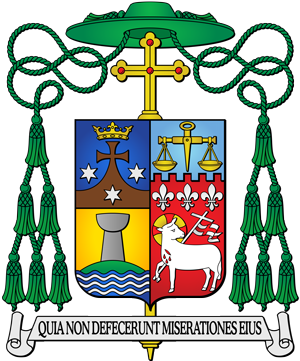
The Coat of Arms of the Most Rev.
ROMEO DUETAO CONVOCAR
Bishop of Chalan Kanoa
BLASON
Dexter side (Dimidiated coat of arms of the Diocese of Chalan Kanoa):
Party per fess, in Chief Azure, a pile reverse with a cross pattée issuant from its apex, all Brunatre, in chief a coronet Or surmounting the cross pattée; over all, three stars Argent, two in chief and one in base; In base of the third a haligi (latte stone) proper atop a mound Vert issuant from a barry wavy of seven Azure and Argent.
Sinister side (Personal coat of arms of Bishop Romeo Duetao Convocar):
Gules, a wounded Paschal Lamb Argent passant and riguardant, nimbus Or charged with a cross of the first, supporting with its Dexter shoulder a banner of the second charged with a cross also of the first; in chief three fleurs de lis Argent; a Chief Celeste embattled charged with a balance scale Or.
Behind the shield is a bishop’s cross, all are surmounted by a Roman galero with six tassels pendant at both sides in 1, 2 and 3 all Vert.
Motto: “Quia non defecerunt miserationes eius”, “For his mercies have never failed”
As per ecclesiastical heraldic tradition, the coat of arms of the incumbent bishop is impaled with the coat of arms of his jurisdiction, the Diocese of Chalan Kanoa, symbolic of his spiritual marriage to his See. The dexter (viewer’s left) side has the place of honor in heraldry, thus the Diocese’s coat of arms is to be placed at the dexter.
The shield is divided horizontally into two equal parts, called “per fess” in heraldry.
In chief Azure (blue) is the Carmelite emblem surmounted by a crown. These symbolize the Blessed Virgin Mary through her title as Our Lady of Mount Carmel, the principal patroness of the Diocese.
In base Or (gold) is a Chamorro latte stone represented in its natural colors, common in the islands of Northern Marianas. It sits atop an island in Vert (green) upon a barry wavy of seven depicting the waves of the ocean, to symbolize the islands of Rota, Saipan, Tinian, and the Northern Islands.
The impalement of the diocesan coat of arms with the personal arms of the incumbent bishop emphasizes that, although the bishop may change, the Church of God in the Diocese of Chalan Kanoa continues unchanged. On the sinister side is the personal coat of arms of Bishop Romeo Duetao Convocar.
The field colors of Gules (red) and Celeste (pale blue) refer to the colors of the rays coming from the Heart of Jesus in the image of the Divine Mercy. The red color represents the Blood of Jesus which is the Life of Souls and the pale blue represents water which makes the soul righteous. This reflects the Bishop’s deep personal entrustment of himself, his mission, and the flock that he cares in the merciful and faithful love of Jesus the Good Shepherd.
The balance scale in chief speaks of his strong sense of justice that characterizes and guides the Bishop as he continues to give special care and attention to the afflicted, abused and downtrodden members of the community.
The bleeding Paschal Lamb speaks of Christ’s sacrifice on the cross and his victory over sin and death, the core element of the Bishop’s ministry celebrating and proclaiming the saving action of Christ. It is through the sacrifice of the Lamb of God that God’s justice and mercy met, reigned, dispensed, and received.
The three fleurs de lis symbolize the Bishop’s Marian devotion, especially to Our Lady of Lourdes. His late mother who was primarily instrumental in nurturing the Bishop’s vocation was a strong devotee to the Blessed Mother under this title. The Bishop’s home parish where he was ordained to the priesthood on the 17th of September 1996 was also under the
patronage of this Marian title.
The embattled line of the chief symbolizes the bishop’s personal history as a seminarian and priest of the Military Ordinariate of the Philippines. This speaks too of his strong sense of awareness of the spiritual warfare of our times and the need to provide a strong spiritual leadership for a renewed church.
“Quia non defecerunt miserationes eius” is the Bishop’s motto, adapted from Lamentations 3:22, “For His mercies have never failed.” This motto guides the Bishop in his ministry, proclaiming the compassion of God in a wounded world.
Heraldic Designers:
Very Rev. Msgr. John Brillantes
Adviser of Escudos Eclesiasticos PH
Life Member of the American College of Heraldry
Mr. Johnel Dimco
Head Researcher of Escudos Eclesiasticos PH
Chief Artist of Auxilium Christianorum Ecclesiastical Heraldic Arts
Statements & Messages
April 21, 2025
Dear brothers and sisters,
It's with great sadness that I share the news of Pope Francis' passing. May we find comfort in our faith and the hope of eternal life.
As we mourn Pope Francis' passing, let us remember that Pope Francis' leadership transformed the Church with compassion, humility, and mercy. He challenged us to serve the most vulnerable and inspired a new era of faith, inspiring us to walk together as a synodal church. May his legacy continue to guide us.
A memorial service in our Diocese for the repose of his soul will be scheduled and will be announced later. For now, we include in all the Masses in our churches the prayers for the repose of his soul and for the guidance for our Holy Mother Church.
May his soul rest in peace! Amen.
/s/ Most Rev. Romeo D. Convocar, D.D.
Bishop of Chalan Kanoa
Pastoral letters
PASTORAL LETTER
On Hope Amidst the Storm
Easter Season 2026
Prot 2026-02-012
To the Clergy, Religious, and Lay Faithful of the Diocese of Chalan Kanoa
Beloved brothers and sisters in Christ,
Grace and peace to you in the Risen Lord.
As we continue to journey through the Easter season, the Church proclaims with joy that Christ is risen and life has triumphed over death. Yet amid this hope, our Northern Marianas were struck by Typhoon Sinlaku (April 13–16, 2026), bringing fear, loss, and uncertainty to many families.
In this time of suffering, the message of Easter becomes even more real. In the Gospel, Jesus calms the storm (cf. Mark 4:39), reminding us that He is with us even amid chaos. He does not abandon His people but speaks peace to our fears. Though the storm has left deep wounds, we hold fast to our faith: the Risen Christ walks with us. We see His presence in the generosity of neighbors, the service of responders, and the resilience of families rebuilding their lives. Let us not lose heart. Let us pray for one another, support those in need, and rebuild our communities in faith, hope, and love.
Therefore, I call upon all parishes, communities, and organizations to continue extending assistance to those in need. Those who have the capacity to help may do so through hot meals, relief packs, or cash donations for our damaged churches particularly the churches of San Roque and San Jose Tinian. If you wish to donate, kindly refer to our diocese Facebook page for bank account details.
Let our Churches be places of refuge, healing, and solidarity. In this way, we become living witnesses of the Resurrection we proclaim.
May the Blessed Virgin Mary, Star of the Sea, intercede for us and guide us safely through every storm.
Yours in the Risen Christ,
✠ MOST REVEREND ROMEO D. CONVOCAR, D.D.
Bishop of Chalan Kanoa
EPISCOPAL ORDINATION AND CANONICAL POSSESSION OF HIS EXCELLENCY,
Most Reverend Romeo D. Convocar, DD
ROMAN CATHOLIC DIOCESE OF CHALAN KANOA
The Roman Catholic Diocese of Chalan Kanoa is an ecclesiastical territory or diocese of the Catholic Church in the United States. It comprises the territory of the Commonwealth of the Northern Mariana Islands and is a suffragan of the Metropolitan Archdiocese of Agaña.
CONTACT US
Diocesan Curia
3010 Chalan Bithen De Carmen, Chalan Kanoa II, Saipan 96950,
Northern Mariana Islands
P.O. Box 500745, Saipan MP 96950
Tel. No.: 1 (670) 234-3000
Fax No.: 1 (670) 235-3002
Email: info@rcdck.org
© 2026 The Roman Catholic Diocese of Chalan Kanoa. All rights reserved.